
All wars are banker’s wars.
Some considerations when reading:
I wrote this for fun, it is not that serious, nevertheless, I welcome corrections, suggestions and comments (citations preferred). This is my genuinely held belief and opinion… I obviously don’t make the rules, though I am interested in them; the pure unadulterated joy I feel witnessing the fall of the West cannot be understated. It is time to pay the piper. The desperate hysterical delusional blood thirsty rhetoric coming out of Europe currently is a symptom of this sharp decline and should be taken as such.
I have such a reverent gratitude for the communist and resistance movements across the global south from the Sahel Alliance, the DPRK, Communist China, Ansar Allah, Cuba, Venezuela and Mexico to, of course Mother Russia and all those in between. During a recent meeting in Beijing Putin expressed to Xi Jinping that “one day apart feels like three autumns” providing a wonderful example of the poetry, love and comradeship the empty cruel western ruling classes will never know or feel. The short line conveys a respect and appreciation I could only dream of in my settler colonial home.
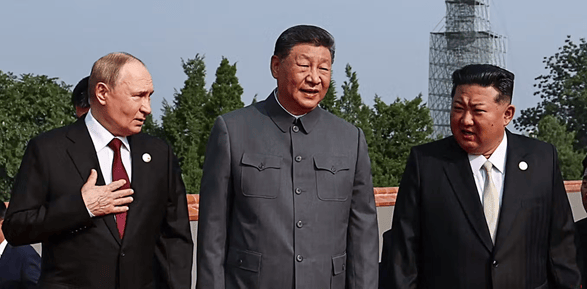
My Angels meet in Beijing to Celebrate the 80th anniversary of the end of WWII (Conversation, 2025)
I also note that the theft, dishonesty and flagrant disregard for treaty obligations described in this post is alleged, while Russian courts would agree with me, the incompetent entitled duplicitous Europeans do not. That being said, I obviously have not read any of the pleadings subject in this post, as they have not been made available, however, I have attempted to be reasonably thorough in my approach.
If you don’t understand that Ukraine has suffered a humiliating loss, I have a very nice bridge in Sydney Harbor to sell you. It is a great tragedy that so many Ukrainians have been sacrificed for the uncaring failure that is the American empire. Zelensky is a fool, with Zionists on one shoulder and Nazis on the other.

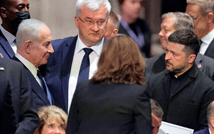

Left: Ukrainian President Vlodymyr Zelensky pictured with notorious neo-Nazi Azov Battalion founder Andriy Biletsky (Grayzone, 2023)
Centre: Netanyahu and Zelensky at Lindsay Graham’s funeral (Times of Israel, 2026)
Right: Albanese and Zelensky embrace at UN meeting (Guardian, 2026)
Russia vs The West
In February of 2022 Russia launched a special military operation in Ukraine per Article 51 (chapter VII) of the Charter of the United Nations (UN Charter) in response to the persistent and hostile expansion of the North Atlantic Treaty Organisation (NATO) (Putin, 2022). Within days, the Council of the European Union (EU) prohibited “transactions with the Russian Central Bank or any legal person, entity or body acting on behalf or at the direction of the Russian Central Bank“, immobilising and subsequently seizing Russia’s financial assets as part of a vast and punitive “sanctions” regime (Council of the EU, 2022). Unsurprisingly, the Bank of Russia is suing. This dispute presents an interesting example of how cross-border disputes will be litigated as the American empire withers and dies. The theft of Russia’s sovereign assets is little more than a desperate bid to temporarily ward off insolvency. Such behaviour will only serve to deepen the legitimacy crisis facing Western finance, while handing Russia a remarkable strategic advantage on a golden platter.
The Assets
The exact sum of Russian assets immobilised in the EU is unclear, though, most sources note varying numbers well in excess of USD$200 billion, with a majority held in Brussels-based Euroclear (Fabrichnaya & Porter, 2026). The asset pool was largely made up of debt securities, specifically government bonds; which have substantially matured into cash (Caprile, Peters & Almeida, 2025). The assets have been reinvested by Euroclear and generated considerable profits; the EU has begun to burglarize said profits to fund Ukraine’s failing military efforts (Euroclear, 2026; Gloy, 2025; Kirby, 2025; Conner & Wessel, 2025).
Come July 2026 Euroclear will have transferred an estimated €8 billion to the EU (Euroclear, 2026). At the last transfer of funds (April 2026) Ursula von der Leyen said: “These €1.4 billion will be directed where they are needed most: to sustain the Ukrainian State, preserve essential public services and support the brave Ukrainian Armed Forces. Our commitment to Ukraine’s victory and freedom is unwavering” (European Commission, 2026). However, the funds are substantially being used to repay loans already made by the EU to Ukraine; 95% of the funds are being directed to the Ukraine Loan Cooperation Mechanism (ULCM) with the remaining 5% going to the European Peace Facility (EPF) (European Commission, 2026).
EPF is a funding mechanism for the provision of material, technical and logistical support (European Commission, 2021). Such support includes: “A broad range of lethal and non-lethal equipment […] including, ammunition, missiles, radars, armoured vehicles, maritime vessels protective personal equipment, cyber defence, night vision goggles, military field hospitals, combat dress. [..] infrastructure works such as military camps, storage facilities, naval bases, air academies, and medical facilities […] hands-on training […] to the armed forces” (European Commission, 2021). Presumably, a sizable portion of this will go directly to Western defence contractors, how nice for them. As Major General Smedley D. Butler famously said War Is a Racket.
UCLM is a Macro Financial Assistance loan of up to €35 billion (European Commission, 2024). The EU described using stolen Russian assets to fund the loan as a “novelty” (European Commission, 2024). The structure of this funding mechanism is absurd in the extreme, the European Commission states the loan is “guaranteed by the EU budget” while the EU plans to repay the loan themselves by misappropriating “revenues generated by Russian Central Bank assets which are immobilized in EU custodian banks” (European Commission, 2024).
Russian Foreign Ministry Spokeswoman Maria Zakharova accurately described the conduct in a recent press briefing, stating: “[…] any operations they conduct with our assets without Russia’s consent are unlawful. What the European Commission is doing is outright robbery, and any attempts to whitewash it with pseudo-legal statements, wording or invented slogans are untenable” (Tass, 2026).
The EU’s Pseudo-legal Strategy
There are multiple issues with the EU’s behaviour, subject in this post. The first issue is asset immobilisation, which is, prima facie unlawful under international and EU law (arriving at this conclusion requires an honesty I do not believe the EU is capable of). The second issue is the use/confiscation of the assets by Euroclear and the EU, the justification of which is laughable. There are multiple layers to the EU’s reprehensible conduct. Emotional and desperate extrajudicial assessments made by supranational organisations does not a solid case make, this buffoonery will catch up to the European ruling class one way or another.
The Sanctions
UN Charter
In a great act of hypocrisy and dishonesty, the EU arbitrarily invoked Article 2(4) of the UN Charter. Article 2(4) provides: “All Members shall refrain in their international relations from the threat or use of force against the territorial integrity or political independence of any State, or in any other manner inconsistent with the Purposes of the United Nations”.
Though it would appear the West works on a rules for thee and not for me basis, given the EU’s position is that Russia’s military operation in Ukraine was “unprovoked and unjustified” (European Commission, 2024). This is demonstrably untrue, there is a vast documented history of Western interference in the territorial integrity of Ukraine and by extension Russia through various institutions including NATO, the National Endowment for Democracy, the US State Department and the CIA among others, from the Cold War to the 2014 Maidan Coup to the failure of Minsk (Klarenberg, 2026). The West has persistently attempted to sabotage Russia through regional proxies (Parampil, 2021). Therefore, Russia’s military action was provoked and is justified.
In any case, breaches of Article 2(4) are determined by a resolution of the UN Security Council per Article 39 of the UN Charter. Article 39 provides: “The Security Council shall determine the existence of any threat to the peace, breach of the peace, or act of aggression and shall make recommendations, or decide what measures shall be taken in accordance with Articles 41 and 42, to maintain or restore international peace and security”.
No such determination has been made (UN, 2022). Not only is Russia a permanent member of the UN Security Council with veto power, but the nation should also enjoy the protection of Article 51 as the Western desire to provoke a regional conflict has been extensively chronicled in leaked and declassified intelligence correspondence (Klarenberg, 2026). Additionally, the Donbass People’s Republics (disputed Russian territories) requested Russia’s assistance to defend against Ukrainian hostility following local independence referendums the West refuses to recognise (Nebenzia, 2022). Russia immediately reported the measures taken in accordance with Article 51 as required by the text of the Article. It should be noted Ukraine has not notified the Security Council in this capacity. Article 51 of the UN Charter provides: “Nothing in the present Charter shall impair the inherent right of individual or collective self-defence if an armed attack occurs against a Member of the United Nations, until the Security Council has taken measures necessary to maintain international peace and security. Measures taken by Members in the exercise of this right of self-defence shall be immediately reported to the Security Council […]”.
Given the UN Security Council has not delivered a determination on Article 2(4), per Article 39 the EU can not issue sanctions under Article 41 of the UN Charter. Article 41 provides: “The Security Council may decide what measures not involving the use of armed force are to be employed to give effect to its decisions, and it may call upon the Members of the United Nations to apply such measures. These may include complete or partial interruption of economic relations and of rail, sea, air, postal, telegraphic, radio, and other means of communication, and the severance of diplomatic relations”.
Europe’s Unilateral Coercive Measures
Despite the failure of the UN Security Council resolution, the EU clings to Article 2(4) in the hope it will excuse these unjustified measures in domestic courts (General Assembly Resolution 377 is not a viable option, nor is the ICJ, such actions will not be enforceable). The EU describes the measures as “sanctions” or “restrictive measures”, as a thinly veiled attempt to obscure the illicit nature of the measures. The term (sanction) is not defined as part of any internationally binding legal instrument, though is usually taken to mean “measures taken by one State to compel a change in policy of another State” “which is either provided for or simply not prohibited by international law” (Human Rights Council, 2012; Arangio-Ruiz, 1991). Sanctions are lawful acts often used to punish as well as secure cessation and/or reparations (Arangio-Ruiz, 1991; Scott, 2014).
Accepting this definition as authoritative (as discussed in numerous preparatory and explanatory documents drafted by various UN bodies), lawful sanctions include retortion and reprisals but not unilateral measures (Arangio-Ruiz, 1991). The principle of sovereign equality (see also: principle of non-intervention) necessitates a vertical relationship between the sanctioning and the sanctioned, thus are only applied between members of an international organisation where members have consented to the possibility (Article 2(1) of the UN Charter; Guerreiro, 2025). Where no breach of Article 2(4) is established, nor any other applicable wrongful act substantiated, as in the present case, the measures are to be taken as unilateral and are prima facie unlawful (Guerreiro, 2025; UN, 2001); ergo, immobilising Russia’s assets is unlawful.
The European Union’s Policy Approach
Sovereign Assets Immunity
Another biproduct of the principle of sovereign equality is sovereign asset immunity (United Nations, 2004). The doctrine protects foreign states from legal proceedings and asset seizure. A nation state may expressly waive immunity, though it is unlikely under the subject circumstances. There are two general approaches adopted by most jurisdictions, absolute or restrictive. The absolute approach protects sovereign assets through commercial proceedings while the restrictive approach does not. EU nations tend to favor the restrictive approach, surprise (Barker & Bienvenu, 2017). There are tests to differentiate between sovereign and commercial activities undertaken by nation states (Nakajima, Okada & Nisugi, 2024). Central bank transactions are generally accepted to be a sovereign activity, the assets in question are of those of the Russian central bank (Bank of Russia or CBR), thus should largely fall within this remit and enjoy the benefits of immunity (van der Horst, 2023). Regardless of immunity status, one would expect their foreign held assets should be protected from theft. Assets seizure without an appropriate court order is in fact theft.
Confiscation and Immobilisation
There is of course a substantial difference between asset immobilisation and asset seizure. Immobilising assets prevents use and access without a change in ownership whereas seizure or confiscation permanently changes ownership of assets. Assets are often immobilised pending a confiscation order and/or damages award (European Commission, n.d.). To immobilise or confiscate assets, a governing body should have established a specific legitimate legal justification for doing so; the EU has not.
In December 2025 the EU invoked Article 122 of the Treaty on the Functioning of the European Union (TFEU) under pressure from the International Monetary Fund (still bitter Putin wisely slipped their debt noose), allowing the EU to circumvent the biannual unanimous vote required under the Lisbon Treaty (see also: Article 215 of the TFEU) to renew the immobilisation measures (European Commission, 2009; European Commission, 2025; Sorgi & Smith-Myer, 2025; Council Regulation 2025/2600). The assets will now remain immobilised indefinitely, even where sanctions on Russia are lifted per Council Regulation 2025/3501 despite warnings from Euroclear’s chief executive Valérie Urbain, Belgium prime minister Bart De Wever and Hungary’s Viktor Orban (Kirby, 2025).
The use of TFEU Article 122 is dubious at best. Article 122 provides the EU Council “may decide […] measures appropriate to the economic situation” where “severe difficulties” arise for member states. The explanatory memorandum accompanying Regulation Proposal 2025/3501 (later adopted as Regulation 2025/2600) describes the legal basis on which the EU believes it is entitled to the use of TFEU Article 122, noting: “the intervention is justified by the need to preserve the stability of the economy of the Union” and “also aims at allowing Ukraine to be able to support its fiscal needs as a country at war while also increasing the industrial defence cooperation between the Union and Ukraine to reinforce their mutual capacities to preserve their security”. If some vague notion of economic instability and the quaint aspirations of a non-member state are adequate, the EU is a deeply unserious institution. Financial instability inside the EU is, of course, inevitable; Russia’s assets are simply buying the EU time. Decades of reckless fiscal, monetary and regulatory policy will have that effect. Perhaps why the EU appears rather hazy on the details. Russia cannot and should not be blamed for the EU’s liquidity issues.
Ineffectual leadership does not entitle said leadership to commit larceny, particularly in the context of Article 17 of the Charter of Fundamental Rights of the European Union (CFR), which provides: “Everyone has the right to own, use, dispose of and bequeath his or her lawfully acquired possessions. No one may be deprived of his or her possessions, except in the public interest and in the cases and under the conditions provided for by law, subject to fair compensation being paid in good time for their loss. The use of property may be regulated by law in so far as is necessary for the general interest”.
The aforementioned Article obviously provides for the protection of property and exceptions thereto; in short, property can be regulated or confiscated where it is in the public or general interest as “provided for by law”. The phrase “provided for by law” in the text of the Article should be understood to encompass the quality of the law as expressed in the preamble of the CFR, requiring it to be compatible with the rule of law and “international obligations common to the Member States” (Malone v United Kingdom, 1984). The EU’s flagrant disregard for the rule of law and its international obligations is clearly detailed throughout this post. Setting those prerequisites aside, courts often allow wide discretion in deciding matters of public or general interest (Takahashi, 2002). However, there are some constraints, of which the EU would not be likely to clear on reasonable and honest assessment.
Per the general principles of European Community law, courts may consider the proportionality of any interference with property rights in relation to achieving legitimate objectives pertaining to the public or general interest (R. v Ministry of Agriculture, Fisheries and Food Ex p. FEDESA, 1991; Flaminio Costa v E.N.E.L., 1964). If measures taken are to be considered proportionate, they must be suitable for achieving the stated objectives.
In the present case, the EU states the measures are aimed at ending the Russia/Ukraine conflict, weakening Russia’s economy, constraining Russia’s banking system, shipping operations and energy revenues (European Council, 2026). Rather than accomplishing these objectives, the EU appears to be committing acts of self-harm by implementing the subject unilateral measures (Biden blowing up Nord Stream aside), while Russia’s economy continues to grow (Rosstat, 2026; Trading Economics, 2026). Russia’s financial position is even enviable, especially in the context of the American’s foolish activities in the Strait of Hormuz, despite any suggestions to the contrary in Western corporate media. The Russians offered a salient example of this self-harm in November’s (2025) formal WTO meeting, describing the EU’s behaviour Russia noted: “For the sake of political ambitions, they blindly continue to jeopardize the functioning of the global energy market and to worsen their domestic economic problems, threatening their national competitiveness. Industrial electricity prices in the European Union are two times higher than those in the US”. This claim is proven out by the swift de-industrialisation of Germany (Schmidt, 2025). Not to mention the erosion of trust in European finance in the whole, as admitted by certain EU member states themselves (BBC, 2025). Perhaps the EU may have some luck with the 22nd sanctions package though, that ought to do it.
The courts have also found that deprivation of property, of the sort described in Article 17 of the CFR not only covers an overt transfer of ownership but also measures that amount to deprivation in the absence of title transfer, this is often referred to as Indirect taking. Sporrong and Lönnroth v Sweden provides: “the Court…must look behind the appearances and investigate the realities of the situation complained of…Since the Convention is intended to guarantee rights that are ‘practical and effective’…it has to be ascertained whether that situation amounted to a de facto [deprivation]” (Escarcena, 2023). This is particularly relevant to Russia’s assets, given the EU asserts the assets have merely been immobilised and not confiscated.
Schrodinger’s Asset Confiscation
A recent EU Court of Justice judgement (CJEU), SBK Art C 465/24, affirmed the meaning of ‘freezing of funds’ within EU Council Regulation No 269/2014, finding: “ […]the ‘freezing of funds’ is not supposed to deprive the persons affected of their property, such a measure [is] by nature, as […] apparent from Article 6 of Decision 2014/145, temporary and reversible”.
Article 6 of EU Council Decision 2014/145 concerning [coercive] measures in respect of actions undermining or threatening the territorial integrity, sovereignty and independence of Ukraine provides: “This Decision shall be kept under constant review. It shall be renewed, or amended as appropriate, if the Council deems that its objectives have not been met”.
In RT France T 125/22, RT claimed the EU’s measures were not temporary and irreversibly undermined their interests as the measures did not include a clear and objective time limit. The Court rejected this assertion on the basis the measures were subject to “constant review” and could be maintained until the established criteria ceased to be satisfied. Thus, it should follow in the present case the measures against Russia’s sovereign assets are not temporary or reversible given the measures are no longer directly subject to review; notwithstanding the difference between immobilised, referring to sovereign assets only, and frozen. Like that distant cousin you have not met the review is now twice removed, the EU did stress in Regulation 2025/2600 that the suspension of the normal review process was temporary and would be subject to review yearly beginning December 2026, presumably to clear this hurdle, though if the EU courts have an appetite for this level of desperate bureaucratic lunacy it will be appropriate to call time of death on the rule of law in the Union. This very well could amount to de facto confiscation, especially where figures like Kaja Kallas, EU High Representative of Foreign Affairs and Security Policy, make statements to this effect without a legitimate claim to damages or reparations: “[it is] unthinkable that Russia will ever see this money again unless it fully compensates Ukraine [for damage caused by the war].” “We don’t see them paying for the damages. So we need to have an exit strategy [for using the assets whenever the war comes to an end]” (Gray, 2025).
Nevertheless, the EU has expressly stated they intend to overtly confiscate the assets well in advance of the war’s conclusion in the unlikely event a plan amenable to Belgium and Euroclear can be devised. A proposal to convert the assets into a zero-interest loan, December 2025, failed as some EU members wisely felt the legal and political risks were far too great (Genovese, 2026). Belgium’s foreign minister Maxime Prevot was firmly against the idea, noting: “Those assets are solidly protected under international law […] confiscating them would trigger systemic financial instability and also erode trust in the euro” (Gray, 2025).
There has been a renewed push, September 2026, to confiscate as Ukraine faces a €23 bn shortfall in defence funding for the year having exhausted the existing €90 bn support loan roughly 6 months ahead of schedule (I am sure the recent corruption scandals have nothing to do with the lack of funds) (Murdoch, 2026). This new proposal seeks to overcome Belgium’s objections. According to reports, the proposal suggests the creation of “a new mechanism” essentially indemnifying Belgium’s liability. However, this only overcomes one of multiple objections, the proposal does not overcome the “systemic financial instability” or the probable loss of trust in the euro (Liboreiro, 2026; Gray, 2025). In a recent statement Prevot reaffirmed Belgium’s stance, stating: “[…] Belgium’s position, […] has remained unchanged for a year. The reasons behind our opposition have not magically disappeared […]” (Liboreiro, 2026). Belgium’s refusal is exceptionally rational, when one considers just how Russia’s immobilised assets have been reinvested. Von der Leyen and Costa should take heed of the tale Moby Dick; Captain Ahab’s obsession ultimately destroys his ship and takes his life as the whale he sought to kill swims away.
Reinvestment and Windfall Profits
In Council Decision 2024/577 the EU amended Decision 2014/512 providing for the prohibition on transactions to allow the reinvestment of the accruing cash balances (as bonds mature) for the purpose of “balance sheet management”. Further, the EU decided: “Unexpected and extraordinary revenues do not have to be made available to the Central Bank of Russia under applicable rules, even after the discontinuation of the transaction prohibition. Thus, they do not constitute sovereign assets. Therefore, the rules protecting sovereign assets are not applicable to these revenues.” (Council Decision 2024/1470). Nor did the EU believe the central securities depositories (CSD), whom hold the assets, should “expect to gain an undue and unintended economic benefit” from the revenues either.” (Council Decision 2024/1470). Naturally, they were used for the maintenance of Ukraine’s failing war effort and the service of debts already levied (as described above).
Again, there is an entirely untenable level of hubris and absurdity in this arrangement, the European ruling class should note that wax wings do melt in the sun. The definition of windfall profits (colloquial) adopted in the legislation provides an apt example thereof: “unexpected and extraordinary revenues result[ing] […] from the implementation of the restrictive measures” (Council Decision 2024/1470). While it is unusual for a CSD to retain customer cash balances at close of business (as they are non-remunerated), is it unexpected? Hardly. The EU may feign surprise until the proverbial cows come home, however, there is an obvious causal issue here that no man on the Clapham omnibus could rationally ignore. But for the EU’s unlawful unilateral coercive measures and legislated reinvestment carveout the revenues would not exist; revenues the EU deliberately brought about, by definition, can not be unexpected. This has yet to be tested in the courts in any case (as far as I can tell).
The reinvestment may serve multiple purposes for the Union, not only does it generate revenues to appropriate for Ukraine, but the reinvestment may also be creating the illusion there is more demand for Eurozone treasury bills than genuinely exists. While there is little transparency around where the assets have been reinvested, there is a good chance they’ve been placed in Eurozone treasury bills or commercial paper through money market funds as Euroclear appears to have a low appetite for risk in relation to Russia’s immobilised assets (Wessel, 2025). The gross issuance of Eurozone treasury bills for Q1 2026 was €478 bn (AFME, 2026). Since the beginning of the Ukraine War, the eurozone has steadily increased treasury bill issuance Q1 YoY, whilst European banks have been tightening credit standards with rising inflation translates into lower treasury demand and capital flight (AFME, 2026; European Central Bank, 2026). Given there is up to €200 bn in Euroclear’s custody available for reinvestment, the possibility is less than remote. As treasury bills are a short-term debt instrument with a duration of 3 -12 months, Russia’s assets may very well be improving the appearance of the EU’s fiscal position each quarter, surreptitiously holding down yields even while conditions rapidly deteriorate. In recent history treasuries, particularly those in the EU, have been viewed as a reliable low risk highly liquid asset; however, this was never going to be a permanent condition. There is an unprecedented disruption to the status quo on the horizon and systemically important institutions like Euroclear are particularly vulnerable to market shocks. A Euro crisis is not out of the question.
Euroclear
Euroclear is not an ordinary bank, it is a CSD, as foreshadowed above, as well as a Financial Market Infrastructure provider offering a multitude of services related to European markets/exchanges including: settlement, clearing, triparty collateral management and custodial services. The Bank was originally founded and funded by a J.P Morgan & Co trust in 1968 to settle trades on the emerging Eurobonds markets (Eurobonds differ from Eurozone bonds, Eurobonds are a foreign issued euro denominated debt instrument, whereas, a Eurozone bond is a domestic EU member issued treasury). It has since evolved into one of the world’s largest banks of its kind. The Bank’s clients are largely institutional and deal in a wide range of financial products. Euroclear has approximately €40 tn assets under custody, with a balance sheet worth €237 bn (€200 bn thereof relates to Russia’s immobilised assets) (Euroclear, 2026).
While Euroclear claims it is “one of the safest environments to hold your assets in” and will “make sure you always retain ownership of your assets” that is unlikely to be true unless you are very special (Euroclear, n.d; ESMA, 2017). The bank has a very concerning structure that could be catastrophic; with the potential to swallow Russia’s assets whole along with civilian pension accounts and investment funds (this legislative infrastructure exists across the western world).
This regulatory story begins in the wreckage of the dot-com crash (almost, the Settlement Finality Directive 98/26/EC is also tangentially relevant but will not be explored here). Investors were largely relying on margin debt to purchase tech stocks, using their existing stocks as collateral. The US Federal Reserve raised rates, tech valuations fell, margin calls ensued, forced liquidations followed and $5 tn in paper disappeared. Collateral takers during this period were typically required to seek judicial authorisation prior to enforcement, conduct mandatory court-supervised auctions and may have been bound by strict waiting periods. Creditors were also obligated to provide formal notice to debtors before executing an enforcement action, failure to do so could delay enforcement or completely invalidate a security interest. This arrangement offered a far more balanced relationship between debtors and creditors.
While these requirements were being met, collateral was actively decreasing in value. As you might imagine, banks were not particularly pleased with this entirely foreseeable outcome. It should be obvious, to anyone playing attention that western economies and governments are controlled by finance capital so of course they used this power to deregulate collateral taking under the guise of systemic risk management; though on even the slightest consideration one has to wonder how rapid collateral taking with limited recourse equates long term financial stability and certainty.
In the EU this deregulation came in the form of Directive 2002/47/EC, also know as, the Financial Collateral Directive (FCD). The FCD essentially eliminated the need for judicial oversight and removed those pesky waiting periods across EU member countries.
In April 2004, the European Commission’s Directorate General for Internal Market proposed the creation of “a group composed of experts from academia, public authorities and practicing lawyers” to “address problems of legal uncertainty identified in the context of considering the way forward for clearing and settlement in the European Union” (Internal Market and Services DG, 2004). This eventually became the Legal Certainty Group (Nating Group, 2005).
Later that year, 22 September 2004, then Deputy General Counsel of Euroclear, Diego Devos sent a memorandum to the European Commission’s Directorate General for Internal Market titled: Preparatory information regarding European Legal Harmonisation. The memorandum refers to the implementation of “consolidation and harmonization” initiatives, making multiple related recommendations (De Vos, 2004). Among those recommendations:
- “Removal or modification of requirements that do not recognise the multi-layer holding structure that is the norm in cross-border activities”,
- “recognition throughout the EU of the pooled holding of registered assets through a nominee structure (and the different nature of legal and beneficial ownership) in order to keep registered securities on a fungible basis at local level and protection of the rights of the nominee”,
- “elimination or modification of requirements that directly or effectively require the maintenance of individual records or accounts per beneficial owner”, and
- “Eliminate impediments to free use of collateral cross-border”.
The Federal Reserve Bank of New York (NY Fed) responded to a questionnaire disseminated by the Legal Certainty Group, March 2006, seeking input on the implementation of the recommendations contained in the aforementioned memorandum (Hansen, 2006). The NY Fed lawyers delivered, pertinent quotes include:
- Question (EU): “Where securities are held in pooled form (e.g. a collective securities position, rather than segregated individual positions per person), does the investor have rights attaching to particular securities in the pool?”
- Answer (NY Fed): “No. The security entitlement holder does not have rights attaching to particular securities in the pool, he has a pro rata share of the interests in the financial asset held by its securities intermediary to the amount needed to satisfy the aggregate claims of the entitlement holders in that issue. This is true even if investor positions are ‘segregated.’”
- Question (EU): “Is the investor protected against the insolvency of an intermediary and, if so, how?”
- Answer (NY Fed): “[…] an investor is always vulnerable to a securities intermediary that does not itself have interests in a financial asset sufficient to cover all of the securities entitlements that it has created in that financial asset. […] If the secured creditor has “control” over the financial asset it will have priority over entitlement holders who have securities entitlement with respect to that financial asset. If the securities intermediary is a clearing corporation, the claims of its creditors have priority over the claims of entitlement holders.”
- Question (EU): “What rules protect a transferee acting in good faith?”
- Answer (NY Fed): “Article 8 […] protects a purchaser of a financial asset against claims of an entitlement holder to a property interest in that financial asset, by limiting the entitlement holder’s ability to enforce that claim […]. Essentially, unless the purchaser was involved in the wrongdoing of the securities intermediary, an entitlement holder will be precluded from raising a claim against it.”
- Question (EU): “How are shortfalls [i.e. the intermediary’s position with an upper-tier intermediary is less than the aggregate recorded position of the intermediary’s account-holders] handled in practice?”
- Answer (NY Fed): “[…] The only rule in such instances is that the security entitlement holders simply share pro rata in the interests held by the securities intermediary […] In actual fact, shortfalls occur frequently due to fails and for other reasons, but are of no general consequence except in the case of the securities intermediary’s insolvency.”
The EU did not implement a blanket regime to deal with indirect holding entitlements, referred to as a “security entitlement” in the United States. However, such regimes do exist the domestic law of EU member states. One might only speculate, as to why this is the case, though it seems reasonable to assume banks would prefer their client investors were not privy to the existence of such entitlements; implementing new law where the existing law is sufficient in fulfilling the grotesque desires of the banking sector, would do little more than draw attention to the matter.
In Belgium, the relevant legislation is Belgium Royal Decree No. 62 of 1967 which later went on to inform UNIDROIT securities frameworks/instruments (UNIDROIT Geneva Securities Convention, 2009; UNIDROIT Legislative Guide on Intermediated Securities, 2017). Royal Decree No. 62 introduced the system of fungible securities deposits. As articulated in the correspondence quotes above, depositors hold a pro rata share of homogenous pooled securities. While Royal Decree No. 62 does allow the withdrawal of physical securities, CSDs can immobilise those certificates in favour of electronic book entries, essentially dematerialising those securities in practice as is the regulated norm across other jurisdictions. Even where assets are described as segregated “[all] securities of the same category” “deposited by Euroclear Bank SA/NV participants (i.e. SEB) with Euroclear Bank SA/NV are deposited on fungible basis” thus will be subjected to “a loss sharing provision for the underlying clients of a Euroclear Bank SA/NV participant in case such Euroclear Bank SA/NV participant goes into default”; “furthermore, Belgian law gives the National Bank of Belgium privilege over Euroclear Bank SA/NV’s own proprietary securities to cover e.g. a situation where securities that are held by Euroclear Bank SA/NV with any depositary on behalf of its participants are not enough to cover the actual holdings of such securities by the participants” (Skandinaviska Enskilda Banken, n.d). Thus, it can be inferred investors no longer enjoy the protection of ownership with respect to their financial assets.
The next regulatory catalyst appeared in 2008 with the global financial crisis (GFC). The GFC was largely caused by non-existent credit requirements and over-the-counter (OTC) derivatives. During this crisis banks took advantage of their new collateral taking privileges, repossessing millions of civilian homes across the United States and Europe. As banker Rahm Emanuel famously said at the time “You never want a serious crisis to go to waste. And what I mean by that is an opportunity to do things that you think you could not do before.” (Bright, 2008). And boy, did the banking sector make use of this crisis, the EU took this opportunity to pass Regulation No. 648/2012 adding another asset class to their fungible repertoire.
Regulation 648/2012 dictates standardised OTC derivatives contracts must be processed through a Central Counterparty (CCP). Bespoke OTC contracts are of course exempt from central clearing requirements as they cannot be rehypothecated as the fungible standardised contracts are. Rehypothecation of OTC derivatives requires written disclosure and express consent per the FCD. This is a formality that is given little mind in practice, assuming the banks selling the standardised OTC derivatives, in their thieving wisdom, do not wish to place much emphasis on the matter.
Just after the crisis in 2009 Diego De Vos was appointed General Counsel of the Bank of International Settlements, adopting global standards for financial market infrastructures in line with this memorandum by 2010 (Regulation 909/2014). The EU finalised and codified these standards in Regulations 909/2014 & 2015/2365 (referenced in Decision 2024/577, mentioned above). Regulation 909/2014 simply harmonised timing and settlement conduct, creating a near frictionless environment for cross-border collateral re-use and taking. Whereas Regulation 2015/2365 covers collateral re-use in repurchase agreements, securities or commodities lending, buy-sell back or sell-buy back transactions, and margin lending as well as consent and disclosure thereof.
What does this mean for Russia’s assets?
In the likely event a financial crisis occurs, Russia’s immobilised assets could very well disappear into the ether. While we do not know the specifics of the reinvestment activities, it is reasonable to assume the instruments are fungible and held in pooled form as is standard practice. Council decision 2014/577 does state: “central securities depositories should account for and manage such extraordinary cash balances […] and reserves of the Central Bank of Russia separately from their other activities and should also keep the revenues generated separate”. However, this is of little consequence, as noted above, even so-called segregated assets are pooled.
Assets stored in pooled form may be reused as collateral across multiple transactions and counterparties creating a chain (Alexiou, Pereira & Rodrigues-Gomes, 2025). A failure in the chain can cascade quickly resulting in collateral runs. Suddenly, there is not enough collateral to go round. The largest market participants usually have direct access to CCPs, thus, get first dibs and everyone else is out of luck with no recourse. Such events occurred during the GFC. Financial crises, especially of this scale, are perfectly engineered to transfer wealth from the many to the few or from Russia to Europe in this specific case. Creating a vast indefinite derivatives complex a top a very limited set of primary assets is quite frankly murderous. How such circumstances will impact the enforcement of Russia’s court-awarded monetary damages is yet to be seen.
The Legal Battle
Moscow City Arbitration Court
In December 2025 the Bank of Russia filed a lawsuit with the Moscow City Arbitration Court (Bank of Russia, 2025). The proceedings are closed, however, the Bank of Russia noted the suit “is related to [the] unlawful activities of the Euroclear depository that cause damage to the Bank of Russia and the fact that the European Commission officially considers proposals for direct or indirect use of Bank of Russia assets without authorisation.” (Central Bank of the Russian Federation v. Euroclear Bank SA/NV; Bank of Russia, 2025). The Bank of Russia received a favourable judgement May 2026, much to Euroclear’s chagrin (Euroclear, 2026). Euroclear attempted to appeal the decision and was unsuccessful (Central Bank of the Russian Federation v. Euroclear Bank SA/NV; Bank of Russia, 2026).
Brussels Commercial Court
In response to the loss in Moscow, Euroclear filed a suit in a Belgium civil court, June 2026, hoping to block the enforcement of the Russian ruling (Landauro, 2026). Euroclear argues Belgian courts should have exclusive jurisdiction as Euroclear is headquartered in Brussels (Vodianyi, 2026). In a press release Euroclear said: “[Russia’s] claims are not recognised under EU law and Euroclear does not recognise the court’s jurisdiction.” (Euroclear, 2026).
General Court of the European Union
In case it was not already obvious the Union is aware their behaviour is entirely criminal; they implemented Council Regulation 2026/1848 in July 2026. Article 1(28) of the Regulation allows EU member states to “prohibit Russian natural and legal persons from seeking to recognise and enforce certain orders of Russian courts in any jurisdiction, among other things.” (Bank of Russia, 2026).
The Bank of Russia has filed a claim challenging Article 1(28) with the General Court of the European Union September 2026 (Bank of Russia, 2026). In a press release the Bank stated: “The Bank of Russia believes that these measures contradict the principles of access to justice, legal certainty, and the sovereign immunity of states and their central banks, among other things. Additionally, the mechanism banning legal actions in any jurisdictions, introduced by the EU Regulation, is extraterritorial in nature, which cannot be considered lawful.” (Bank of Russia, 2026).
Enforcement
The EU may continue to complain about the validity of Russian court decisions, though it ultimately will not matter. Euroclear has assets in jurisdictions that will be amenable to the recognition and enforcement of Russian rulings, particularly China. Chinese courts may recognise and enforce foreign judgements where relevant law has been complied with and there is a relevant bilateral treaty namely the Treaty between the Russian Federation and the People’s Republic of China on Legal Assistance in Civil and Criminal Matters (Yu, 2020; Yu, 2024). Article 16 of the treaty provides: “contracting parties are obliged to recognize and, if required by the nature of the judgements, to execute on their territory judgements made in the territory of the other contracting party, namely court judgements in civil cases […]” (Bikbaev, 2024).
In December 2020, Euroclear and the Shanghai Clearing House jointly created the Yulan Bond issuance model giving homeless international capital a place to go (Euroclear, 2020). In 2023, Yulan bonds were integrated into Euroclear’s triparty collateral management offerings (Euroclear, 2023). China, rationally, maintains strict capital controls to protect the yuan and by extension domestic stability (Lee, 2021). Euroclear’s handling of Russia’s sovereign assets does not exactly inspire trust. China has been developing its own domestic alternatives to Euroclear as it becomes increasingly evident the new multipolar world will need to decouple from the aggressive declining West (Long, 2025). At some point in the future, it may be politically advantageous for China to enforce Russia’s damages judgement to accelerate financial bifurcation simply as an act of self-preservation.
References
Nebenzia, V & Putin, V. Letter dated 24 February 2022 from the Permanent Representative of the Russian Federation to the United Nations addressed to the Secretary-General (2022). United Nations Security Council: https://docs.un.org/en/S/2022/154
Council of EU. EU adopts new set of measures to respond to Russia’s military aggression against Ukraine (2022). Press release: https://www.consilium.europa.eu/en/press/press-releases/2022/02/28/eu-adopts-new-set-of-measures-to-respond-to-russia-s-military-aggression-against-ukraine/
Euroclear. Euroclear reports strong growth in business income and profit in Q1 2026 (2026). Media release: https://www.euroclear.com/newsandinsights/en/press/2026/mr-12-euroclear-delivers-q1-2026-results.html
Caprile, A, Peters, T & Almeida, ALM. Confiscation of immobilised Russian sovereign assets (2025). European Parliament: https://www.europarl.europa.eu/RegData/etudes/BRIE/2025/775908/EPRS_BRI(2025)775908_EN.pdf
Bank of Russia. Bank of Russia files lawsuit against Euroclear with Moscow City Arbitration Court (2025). Press release: https://www.cbr.ru/eng/press/pr/?file=639011472901412429OBAUT_E.htm
Fabrichnaya, E, Porter, M. Russian central bank seeks immediate enforcement of ruling against Euroclear (2026). Reuters: https://www.reuters.com/business/finance/russian-central-bank-seeks-immediate-enforcement-ruling-against-euroclear-2026-05-20/
Gloy, A. The Battle Over Euroclear and Russia’s Frozen Billions (2025). Fair Observer: https://www.fairobserver.com/economics/the-battle-over-euroclear-and-russias-frozen-billions/
Conner, A & Wessel, D. What is the status of Russia’s frozen sovereign assets? (2025). Brookings: https://www.brookings.edu/articles/what-is-the-status-of-russias-frozen-sovereign-assets/
European Commission. EU to deliver €1.4 billion in revenue from immobilised Russian assets to be used for support to Ukraine (2026). Press release: https://ec.europa.eu/commission/presscorner/detail/en/ip_26_768
European Commission. A unique funding mechanism – the EPF (2021). What we do: https://fpi.ec.europa.eu/what-we-do/european-peace-facility_en
European Commission. Ukraine Loan Cooperation Mechanism (2024). News: https://ec.europa.eu/newsroom/budget/items/849941/en
Tass: Russian News Agency. EU plans to use Russian assets without consent amount to robbery — Zakharova (2026). Politics: https://tass.com/politics/2134349
Klarenberg, k. Declassified: UK Knew NATO Expansion ‘Would Provoke’ Russia War (2026). Scheerpost: https://scheerpost.com/2026/05/18/declassified-uk-knew-nato-expansion-would-provoke-russia-war/
Parampil, A. US escalates in Ukraine battleground (2021). Mark Sleboda interview: https://thegrayzone.com/2021/04/16/us-escalates-ukraine-battleground/
Article 2(4) of the Charter of the United Nations: https://legal.un.org/repertory/art2/english/rep_supp7_vol1_art2_4.pdf
Article 39 of the Charter of the United Nations: https://legal.un.org/repertory/art39.shtml
United Nations. Russia vetoes Security Council resolution condemning attempted annexation of Ukraine regions (2022). UN News: https://news.un.org/en/story/2022/09/1129102
Nebenzia, V. Letter dated 24 February 2022 from the Permanent Representative of the Russian Federation to the United Nations addressed to the Secretary-General. United Nations Digital Library: https://digitallibrary.un.org/record/3959647?ln=en&v=pdf
Article 51 of the Charter of the United Nations: https://legal.un.org/repertory/art51.shtml
Article 41 of the Charter of the United Nations: https://legal.un.org/repertory/art41.shtml
Hofer, A. The Proportionality of Unilateral “Targeted” Sanctions: Whose Interests Should Count? (2020). Nordic Journal of International Law: https://brill.com/view/journals/nord/89/3-4/article-p399_399.xml?language=en
Ruys, T. Sanctions, Retorsions and Countermeasures: Concepts and International Legal Framework (2016). Edward Elgar Publishing. Forthcoming in Larissa van den Herik (ed.), Research Handbook on UN Sanctions and International Law: https://ilmc.univie.ac.at/fileadmin/user_upload/p_ilmc/Bilder/Bewerbung/Case_1/Tom_Ruys_-_Sanctions_Retorsions_and_Countermeasures_Concepts_and_International_Legal_Framework.pdf
Human Rights Council. Thematic study of the Office of the United Nations High Commissioner for Human Rights on the impact of unilateral coercive measures on the enjoyment of human rights, including recommendations on actions aimed at ending such measures (2012). United Nations General Assembly: https://docs.un.org/en/A/HRC/19/33
Arangio-Ruiz, G. Third report on State responsibility, by Mr. Gaetano Arangio-Ruiz, Special Rapporteur (1991). Extract from the Yearbook of the International Law Commission, vol. II(1): https://legal.un.org/ilc/documentation/english/a_cn4_440.pdf
Scott, RMG. Sanctions, Countermeasures and Human Rights Event Report (2014). British Institute of International and Comparative Law: https://www.biicl.org/documents/238_sanctions_-_12_june_2014_-_event_report_final.pdf
Hofer, A. The EU and Its Member States at War in Ukraine? Collective Self-defence, Neutrality and Party Status in the Russo-Ukraine War (2023). European Papers- A Journal on Law and Integration, vol. 8, no. 3: https://dspace.library.uu.nl/server/api/core/bitstreams/47e280d7-d029-4a5e-bca2-d287abf377fb/content
Article 2(1) of the Charter of the United Nations: https://legal.un.org/repertory/art2.shtml
Guerreiro, A. Are European “Sanctions” Against Russia Compatible With International Law? (2025). Moscow Journal of International Law: https://www.mjil.ru/jour/article/view/2886/2730
United Nations Responsibility of States for Internationally Wrongful Acts (2001): https://legal.un.org/ilc/texts/instruments/english/draft_articles/9_6_2001.pdf
G7 Leader’s Statement (2022). Germany: https://www.g7germany.de/resource/blob/997532/2014234/39e142fa878dce9e420ef4d29c17969d/2022-03-11-g7-leader-eng-data.pdf?download=1
Marrakesh Agreement and its Annexes (1994-2025). World Trade Organisation: https://www.wto.org/english/docs_e/legal_e/legal_e.htm
World Trade Organisation. Australia, Canada, European Union, Japan, New Zealand, Switzerland, United Kingdom, and the United States – Unilateral trade restrictive measures against Russia (ID 77) (2022). Trade Concerns Database: https://tradeconcerns.wto.org/en/stcs/details?imsId=77&domainId=CMA
International Criminal Court. Situation in Ukraine: ICC judges issue arrest warrants against Vladimir Vladimirovich Putin and Maria Alekseyevna Lvova-Belova (2023). Press Release: https://www.icc-cpi.int/news/situation-ukraine-icc-judges-issue-arrest-warrants-against-vladimir-vladimirovich-putin-and
Human Rights Office of the High Commissioner. OHCHR and unilateral coercive measures (accessed 2026). United Nations: https://www.ohchr.org/en/unilateral-coercive-measures
Human Rights Council. Thematic study of the Office of the United Nations High Commissioner for Human Rights on the impact of unilateral coercive measures on the enjoyment of human rights, including recommendations on actions aimed at ending such measures (2012). United Nations: https://docs.un.org/en/A/HRC/19/33
United Nations. United Nations Convention on Jurisdictional Immunities of States and Their Property (2004). Treaty: https://treaties.un.org/doc/source/recenttexts/english_3_13.pdf
Barker, M, Bienvenu, P. International arbitration report (2017). Norton Rose Fulbright: https://www.nortonrosefulbright.com/-/media/files/nrf/nrfweb/imported/international-arbitration-review—issue-8.pdf?revision=f43c37d5-12e0-45e5-9657-1aba5baf359e&revision=5248360953717387904
Van der Horst, R. Illegal, Unless: Freezing the Assets of Russia’s Central Bank (2023). The European Journal of International Law Vol. 34 no. 4: https://ejil.org/pdfs/34/4/3379.pdf
Nakajima, K, Okada, Y, Nisugi, K. The sovereign function test out of thin air? The status of the central bank determined behind the scenes in Certain Iranian Assets (2024). Journal of International Dispute Settlement, Vol. 15, no. 3: https://academic.oup.com/jids/article/15/3/474/7637709
European Commission. Confiscation and freezing of assets (n.d.). Judicial cooperation: https://commission.europa.eu/law/cross-border-cases/judicial-cooperation/types-judicial-cooperation/confiscation-and-freezing-assets_en
European Commission. Explaining the Treaty of Lisbon (2009). Memo: https://ec.europa.eu/commission/presscorner/detail/en/memo_09_531
European Commission. Council Regulation 2025/2600 on emergency measures addressing the serious economic difficulties caused by Russia’s actions in the context of the war of aggression against Ukraine: https://eur-lex.europa.eu/legal-content/EN/TXT/?uri=OJ:L_202502600
European Commission. Emergency measures addressing the serious economic difficulties caused by Russia’s actions in the context of the war in Ukraine (2025). Council Regulation: https://commission.europa.eu/document/download/65ec50b2-81dc-4e00-9e6f-a5ba75123c00_en
Sorgi, G, Smith-Myer, B. IMF support for Ukraine hinges on Russian assets loan, EU warns (2025). Politico: https://www.politico.eu/article/imf-ukraine-russia-loan-eu-financial-support-war-economy/
Consolidated version of the Treaty on the Functioning of the European Union – PART THREE: UNION POLICIES AND INTERNAL ACTIONS – TITLE VIII: ECONOMIC AND MONETARY POLICY – Chapter 1: Economic policy – Article 122 (ex Article 100 TEC): https://eur-lex.europa.eu/LexUriServ/LexUriServ.do?uri=CELEX%3A12008E122%3AEN%3AHTML
Kirby, P. EU backs indefinite freeze on Russia’s frozen cash ahead of loan plan for Ukraine (2025). BBC: https://www.bbc.com/news/articles/c98nnd01g91o
SBK Art Limited Liability Company v Fortenova Group STAK Stichting and Open Pass Limited (2026). Court of Justice of the European Union: https://eur-lex.europa.eu/legal-content/EN/TXT/?uri=celex:62024CJ0465
Article 17 of the Charter of Fundamental Rights of the European Union: https://fra.europa.eu/en/eu-charter/charter/article/17-right-property
Takahashi, Y. The Margin of Appreciation Doctrine and the Principle of Proportionality in the Jurisprudence of the ECHR (2002). Intersentia.
Malone v United Kingdom, Merits, App No 8691/79, A/82, IHRL 47 (ECHR 1984): https://hudoc.echr.coe.int/fre#{%22itemid%22:[%22001-57533%22]}
R. v Ministry of Agriculture, Fisheries and Food Ex p. FEDESA (FEDESA) (C-331/88) [1990] E.C.R. I-4023; [1991] 1 C.M.L.R. 507: https://eur-lex.europa.eu/legal-content/EN/TXT/?uri=celex:61988CJ0331
Flaminio Costa v E.N.E.L. (1964). Document 61964CJ0006: https://eur-lex.europa.eu/legal-content/EN/TXT/?uri=celex:61964CJ0006
World Trade Organisation. Council for Trade in Goods – Formal meeting of 27 November 2025. Trade Concerns Database: https://tradeconcerns.wto.org/en/stcs/details?imsId=189&domainId=CTG
Schmidt, H. Germany Has an Escalating Deindustrialisation Problem (2025). International Banker: https://internationalbanker.com/finance/germany-has-an-escalating-deindustrialisation-problem/
European Council. Russia’s war against Ukraine: EU sanctions (last review: 2026). Explainer: https://www.consilium.europa.eu/en/policies/sanctions-against-russia/
Rosstat. Short-term Economic Indicators (2026): https://eng.rosstat.gov.ru/folder/205320
Rosstat. Statistical Publications (2026): https://eng.rosstat.gov.ru/Publications
Trading Economics. Russia GDP Annual Growth Rate (2026). Summary: https://tradingeconomics.com/russia/gdp-growth-annual
Escarcena, S. Expropriation, Indirect (2023). Oxford Public International Law: https://opil.ouplaw.com/display/10.1093/law-epil/9780199231690/law-9780199231690-e2240
The Association for Financial Markets in Europe. Government Bond Data Report. Q1 2026: https://www.afme.eu/media/3uodfhjw/government-bond-data-report-q1-2026.pdf
European Central Bank. The euro area bank lending survey. First quarter of 2026: https://www.ecb.europa.eu/stats/ecb_surveys/bank_lending_survey/html/ecb.blssurvey2026q1~ff74e51f1b.en.html
Gray, A. EU to work on using frozen Russian assets to aid Ukraine after war (2025). Reuters: https://www.reuters.com/world/eu-work-using-frozen-russian-assets-aid-ukraine-after-war-2025-08-30/
Genovese, V. MEPs push to use frozen Russian assets to support Ukraine (2026). Euronews: https://au.news.yahoo.com/meps-push-frozen-russian-assets-094533326.html
Murdoch, B. EU lawmakers renew push to seize frozen Russian assets as Ukraine faces its toughest winter yet with a €23 billion defense funding gap (2026). Euromaidan Press: https://euromaidanpress.com/2026/09/10/eu-lawmakers-renew-push-to-seize-frozen-russian-assets/
Liboreiro, J. Belgium pushes back against new attempt to use Russian assets to support Ukraine (2026). Euronews: https://www.euronews.com/my-europe/2026/09/02/belgium-pushes-back-against-new-attempt-to-use-russian-assets-to-support-ukraine
Euroclear Bank. Asset classes (n.d, accessed 16/09/2026). Services: https://www.euroclear.com/services/en/asset-classes/asset-classes-euroclear-bank.html
European Securities and Markets Authority. The Distributed Ledger Technology Applied to Securities Markets (2017). Report: https://www.esma.europa.eu/sites/default/files/library/dlt_report_-_esma50-1121423017-285.pdf
Internal Market and Services DG. EC Mandate pertaining to clearing and settlement (2005). Internet Archive: https://archive.org/details/ec-legal-certainty-project/mode/2up
Nating Group. Clearing and Settlement: Commission sets up expert group to consider legal certainty issues (2005). Thomson Reuters Practical Law: https://uk.practicallaw.thomsonreuters.com/3-200-2760?originationContext=document&transitionType=DocumentItem&contextData=(sc.Default)&ppcid=22bdc60dc6ce49cea3708da51c7abc0f&firstPage=true
Devos, D. Preparatory information regarding European Legal Harmonisation (2004). Euroclear, Internet Archive: https://archive.org/details/euroclear-memorandum/mode/2up?q=multi-layer
Hansen, M, J. The New York Fed’s reply to questions posed by the EU Commission regarding clearing and settlement (2006). European Commission, Internet Archive: https://archive.org/details/ec-clearing-questionnaire/mode/2up?q=pooled
European Commission. Regulation (EU) No 909/2014 of the European Parliament and of the Council of 23 July 2014 on improving securities settlement in the European Union and on central securities depositories and amending Directives 98/26/EC and 2014/65/EU and Regulation (EU) No 236/2012 Text with EEA relevance. Commission Regulation: https://eur-lex.europa.eu/legal-content/EN/TXT/?uri=CELEX:32014R0909
UNIDROIT Geneva Securities Convention (2009): https://www.unidroit.org/instruments/capital-markets/geneva-convention/
Legislative Guide on Intermediated Securities (2017): https://www.unidroit.org/instruments/capital-markets/legislative-guide/overview/
Bright, B. Rahm Emanuel on the Opportunities of Crisis (2008). Wall Street Journal: https://www.wsj.com/video/rahm-emanuel-on-the-opportunities-of-crisis/3F6B9880-D1FD-492B-9A3D-70DBE8EB9E97
Skandinaviska Enskilda Banken. CSDR – Legal disclosure (n.d). Legal notice: https://sebgroup.com/legal-and-regulatory-information/legal-notice/csdr
Alexiou, G, Pereira, S, Rodrigues-Gomes, V. Repo collateral reuse and liquidity windfalls (2025). European Central Bank. Working Paper Series: https://www.ecb.europa.eu/pub/pdf/scpwps/ecb.wp3147~6c60cabb50.en.pdf
Bank of Russia. Bank of Russia files lawsuit against Euroclear with Moscow City Arbitration Court (2025). Press release: https://www.cbr.ru/eng/press/pr/?file=639011472901412429obaut_e.htm#highlight=euroclear
Central Bank of the Russian Federation v. Euroclear Bank SA/NV
Decision of the Moscow Commercial Court A40-345157/25-136-2516 – 16 Jan 2026: https://jusmundi.com/en/document/decision/ru-central-bank-of-the-russian-federation-v-euroclear-bank-sa-nv-resenie-arbitraznogo-suda-g-moskvy-a40-345157-25-136-2516-friday-16th-january-2026#decision_88831
Decision of the Moscow Commercial Court Upholding CBR’s Request for Immediate Enforcement of the Judgment A40-345157/2025 – 26 May 2026: https://jusmundi.com/en/document/decision/en-central-bank-of-the-russian-federation-v-euroclear-bank-sa-nv-decision-of-the-moscow-commercial-court-upholding-cbr-s-request-for-immediate-enforcement-of-the-judgment-a40-345157-2025-tuesday-26th-may-2026#decision_89055
Euroclear. Update on Russian sanctioned assets – May 2026. Press release: https://www.euroclear.com/newsandinsights/en/Format/Articles/russia-our-current-status/update-on-russian-sanctioned-assets-may-2026.html
Landauro, I. Euroclear sues Russian central bank over €220 billion damages claim (2026). Reuters: https://www.reuters.com/business/finance/euroclear-sues-russian-central-bank-over-220-billion-damages-claim-2026-06-30/
Vodianyi, A. Belgian depository holding Russian assets sues Russian central bank (2026). LIGA: https://finance.liga.net/en/bank/news/belgian-depository-holding-russian-assets-sues-russian-central-bank
European Commission. Council Regulation (EU) 2026/1848 of 23 July 2026 amending Regulation (EU) No 833/2014 concerning restrictive measures in view of Russia’s actions destabilising the situation in Ukraine. European Regulation: https://eur-lex.europa.eu/eli/reg/2026/1848/oj/eng
Bank of Russia. Bank of Russia files claim with EU General Court to challenge restrictions on recognition and enforcement of Russian court orders in other jurisdictions (2026). Press release: https://www.cbr.ru/eng/press/pr/?file=639252694853112818obaut_e.htm#highlight=euroclear
Yu, M. List of China’s Bilateral Treaties on Judicial Assistance in Civil and Commercial Matters (Enforcement of Foreign Judgments Included) (2020). China Justice Observer: https://www.chinajusticeobserver.com/a/list-of-chinas-bilateral-treaties-on-judicial-assistance-in-civil-and-commercial-matters
Bikbaev, R. Mutual Recognition and Enforcement of Foreign Judgments and Arbitral Awards of China and Russia: Experience of Cooperation and Development Prospects (2024). Moscow State Institute of International Relations, IX BRICS Legal Forum: https://papers.ssrn.com/sol3/papers.cfm?abstract_id=5023112
Du, G. 2024 Guide to Enforce Russian Judgments in China-CTD 101 Series (2024). China Justice Observer: https://www.chinajusticeobserver.com/a/guide-to-enforce-russian-judgments-in-china
Yu, M. Chinese Court Refuses to Recognize Russian Judgment Due to Due Process (2024). China Justice Observer: https://www.chinajusticeobserver.com/a/chinese-court-refuses-to-recognize-russian-judgment-due-to-due-process
Euroclear. Euroclear Bank and Shanghai Clearing House create new asset class (2020). Press release: https://www.euroclear.com/newsandinsights/en/press/2020/2020-mr-15-yulan-bonds.html
Euroclear. Yulan bonds eligible in Triparty (2023). Triparty Newsletter: https://my.euroclear.com/content/dam/euroclear/operational-public/eb/newsletters/2023/Triparty/2023-T-003.pdf?cid=ON-202304141353-Newsletter-Yulan-bonds-eligible-in-Triparty
Lee, B. China’s capital controls: here to stay? (2021). Central Banking Publications: https://www.centralbanking.com/central-banks/currency/7860946/chinas-capital-controls-here-to-stay
Long, K. How Hong Kong’s Asian settlement house could further split the global financial system (2025). The Banker: https://www.thebanker.com/content/d60525db-a198-4ab8-bc41-214dd25649d1


